
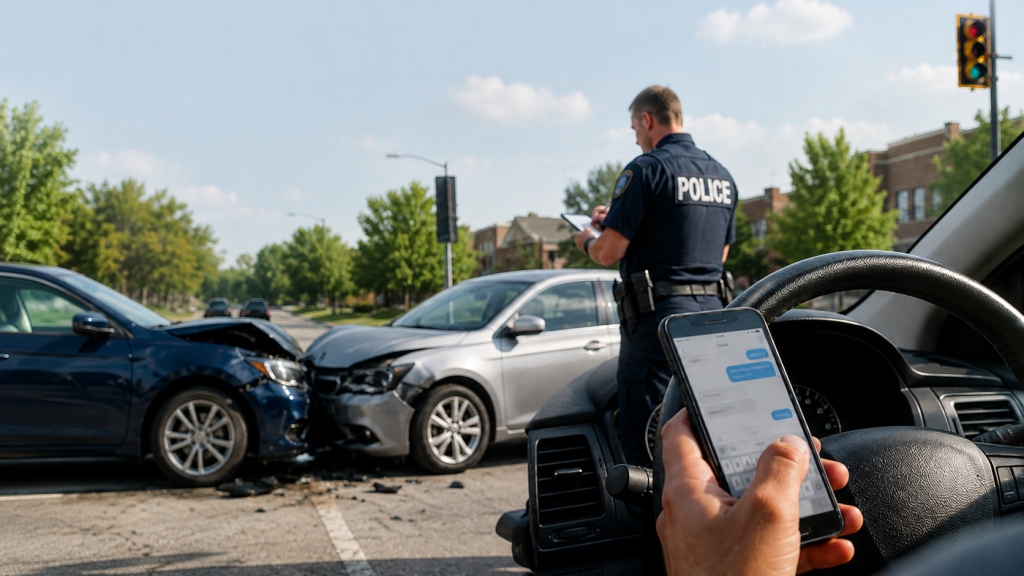
Quick Answer: Distracted driving after a Carmel car accident may be shown through phone-related records, witness observations, dashcam or surveillance video, police documentation, admissions, vehicle data, and the timing of events before impact. No single piece of evidence automatically proves distraction, so several sources that support the same sequence of events can be more persuasive than one isolated fact.
What Evidence Can Show That a Driver Was Distracted?
Distracted driving is not limited to texting. Indiana traffic-safety guidance describes distraction as activity that takes attention away from driving, including phone use, eating or drinking, talking with passengers, or interacting with navigation and entertainment systems. Indiana’s hands-free law also prohibits motorists from holding a telecommunications device while operating a vehicle except in limited circumstances.
Evidence of distraction can come from several places. Phone-related records may sometimes help establish the timing of calls, messages, or other device activity around the crash, although those records are not automatically available simply because a collision occurred and may require formal legal process. Independent witnesses may also have seen the driver looking down, holding a phone, drifting within a lane, failing to brake, or reacting unusually late, while dashcam and surveillance footage can help show lane position, traffic signals, braking, head movement, and what occurred immediately before impact.
A police report may also document driver statements, witness information, citations, vehicle positions, roadway conditions, and observations made by the investigating officer. Indiana crash-investigation training includes roadway evidence, vehicle evidence, crash-scene photography, skid marks, measurements, and driver and witness interviews when analyzing what happened before, during, and after a collision.
How Can Different Evidence Work Together to Prove Distraction?
Timing can make separate pieces of evidence more meaningful when they line up. A phone activity timestamp may have limited value by itself, but it can become more significant if a witness also reports seeing the driver look down and video or vehicle evidence shows a delayed reaction.
Depending on the vehicle and the type of data preserved, electronic information may help reconstruct speed, braking, acceleration, or other events close to impact. That information does not necessarily reveal why a driver failed to react, but it can help establish the sequence of events. For example, little or late braking may become more meaningful when other evidence suggests that the driver’s attention was away from the roadway.
An admission can also matter, but distracted driving does not always require one. A driver who says they were looking at a phone, adjusting navigation, or turning toward a passenger may provide evidence that supports other facts, while witnesses, video, electronic records, police documentation, and physical evidence may still support the claim even when the driver denies being distracted.
The goal is not simply to show that a driver owned or used a phone at some point. The evidence should help connect the distraction to the moments immediately before the collision and show how it may have contributed to the crash.
Why Should Distracted-Driving Evidence Be Preserved Quickly?
Some of the most useful evidence may not remain available indefinitely. Surveillance footage can be overwritten, vehicles may be repaired or salvaged, witnesses can become harder to locate, and electronic records may require formal preservation or legal process before they can be obtained.
Preserve the evidence already available to you and identify potential sources as soon as reasonably possible. Crash-scene photographs, dashcam recordings, witness information, police-report details, and statements made after the collision can help establish a timeline while the events are still fresh. If distracted driving may have caused the crash, delaying preservation efforts can make it harder to obtain evidence that could confirm or contradict what the drivers say happened.
Anthony “Tony” Oliveira of Dennis, Wenger & Abrell, P.C. handles personal injury matters involving motor vehicle accidents in Indiana.
Frequently Asked Questions About Distracted-Driving Evidence
Not necessarily. A citation can be relevant evidence, but fault still depends on the circumstances of the crash and whether the distracted behavior contributed to the collision.
Not automatically. Phone-related information may sometimes be obtained through legal process when it is relevant to a disputed claim, but access depends on the type of record and circumstances.
A credible witness statement can be important, especially when the witness clearly observed the driver looking away from the road, holding a phone, or engaging in another distracting activity. The statement may be stronger when it is consistent with video, vehicle data, police observations, or other evidence.
A distracted-driving claim does not necessarily depend on phone records. Witnesses, video, admissions, police documentation, vehicle data, and the timing of events may still support an argument that the driver was not paying attention.
A denial does not automatically resolve the issue. Other evidence may still show that the driver was distracted or failed to react normally immediately before the collision.
Contact Dennis, Wenger & Abrell, P.C.
If distracted driving may have caused a Carmel car accident, important evidence can become harder to obtain as time passes. Before resolving the claim, consider whether electronic, video, vehicle, or witness evidence needs to be preserved.
Anthony “Tony” Oliveira of Dennis, Wenger & Abrell, P.C. handles personal injury matters involving motor vehicle accidents in Indiana.
Legal Disclaimer
This article is for general informational purposes only and is not legal advice. Reading it does not create an attorney-client relationship with Dennis, Wenger & Abrell, P.C. Distracted-driving claims depend on the specific facts, available evidence, insurance coverage, and applicable Indiana law. Speak with a qualified Indiana attorney about your situation.