
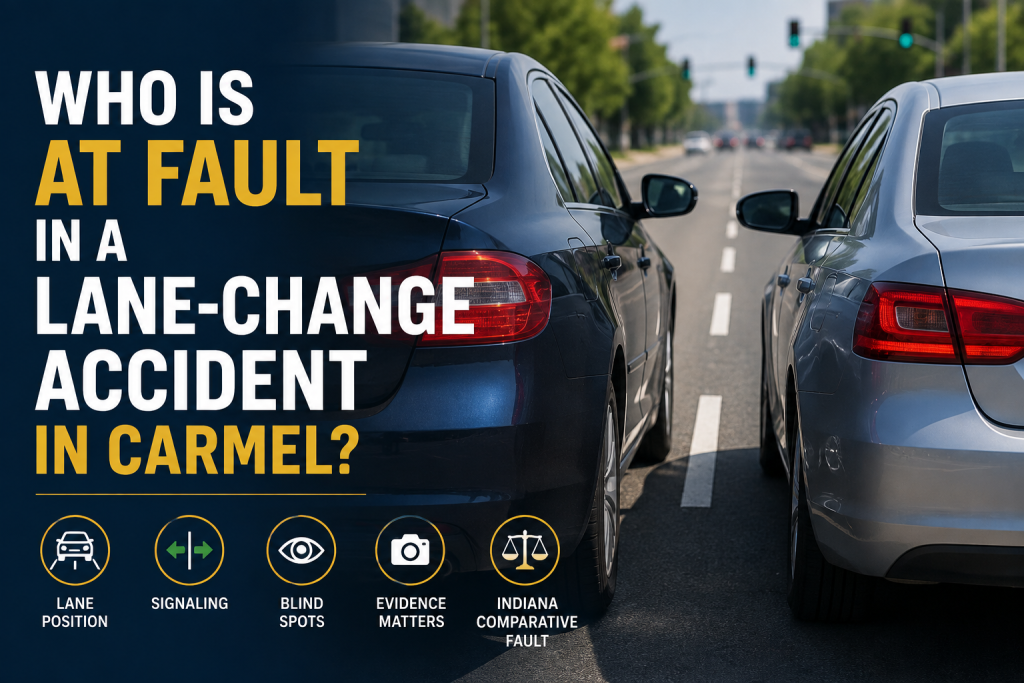
Quick Answer: Fault in a Carmel lane-change accident depends on what each driver was doing before and during the collision. The driver changing lanes may be responsible if the move was unsafe, but another driver may also share fault if speeding, following too closely, or changing lanes at the same time. Vehicle position, signaling, damage, video, witnesses, and other evidence can help show what actually happened.
How Is Fault Determined in a Lane-Change Accident?
A lane-change crash is not automatically the fault of the driver who moved from one lane to another. A driver should signal and make sure the movement can be completed safely, but using a turn signal alone does not prove that the lane was clear or that the maneuver was safe.
Fault can become more complicated when both vehicles are moving, one driver says the other vehicle was in a blind spot, or both drivers begin changing lanes at nearly the same time. A blind spot may help explain why a driver failed to see another vehicle, but it does not by itself establish who was responsible for the collision.
Under Indiana’s comparative-fault rules, responsibility can be divided between drivers when both contributed to the crash, which can affect the amount an injured person may recover. That makes the evidence especially important when each driver gives a different account of what happened.
What Evidence Can Show How the Crash Happened?
When drivers give conflicting accounts, physical evidence can help establish where the vehicles were positioned and how the impact occurred. Photographs of vehicle damage, lane markings, debris, vehicle positions, and the surrounding roadway may help show where contact occurred and how the vehicles were moving.
Dashcam or surveillance footage may show when a vehicle crossed a lane line, whether a signal was used, or whether both vehicles moved toward the same lane at the same time. Independent witnesses may also provide useful information about lane position, speed, signaling, or the sequence of events.
Vehicle damage can provide additional clues about the angle and location of impact, but it is usually most useful when considered with the rest of the evidence. The police crash report may also document driver statements, witnesses, vehicle locations, citations, or other observations made at the scene.
What Should You Do If the Other Driver Blames You?
If the drivers disagree about what happened, preserve the available evidence before resolving the claim. Save photographs and video, keep witness contact information, obtain the crash report when available, and write down what you remember about the vehicles’ positions, traffic conditions, signals, and movements while those details are still fresh.
When speaking with an insurer, describe what you actually observed without guessing about speed, distance, timing, or something you could not see. If the insurance company says you caused the accident, ask what evidence supports that conclusion before assuming that fault determination is correct or signing a settlement release.
Frequently Asked Questions About Lane-Change Accident Fault
Yes. Indiana comparative-fault rules allow responsibility to be divided when more than one driver contributed to the crash. How that affects a claim depends on the percentage of fault assigned to each person.
No. A turn signal shows an intention to change lanes, but it does not automatically give the driver the right to move over. The driver still needs to make sure the lane change can be completed safely.
No. Being in another driver’s blind spot does not automatically make you responsible for a collision. Fault depends on how both vehicles were moving, whether the lane change could be made safely, and what the available evidence shows.
Ask what evidence supports the insurer’s decision and preserve anything that supports your account, including photographs, video, witnesses, and the crash report. An insurer’s initial fault determination may not reflect every piece of available evidence.
Yes. Vehicle damage, roadway evidence, photographs, witness statements, police documentation, and the drivers’ accounts may still help establish how the collision occurred. Video can be useful, but it is not the only way to evaluate fault.
Contact Dennis, Wenger & Abrell, P.C.
If the drivers disagree about how a lane-change crash happened, preserve the available evidence before resolving the claim. Anthony “Tony” Oliveira of Dennis, Wenger & Abrell, P.C. handles personal injury matters involving motor vehicle accidents in Indiana.
Legal Disclaimer
This article is for general informational purposes only and is not legal advice. Reading it does not create an attorney-client relationship with Dennis, Wenger & Abrell, P.C. Fault after a lane-change accident depends on the specific facts, available evidence, insurance coverage, and applicable Indiana law. Speak with a qualified Indiana attorney about your situation.