
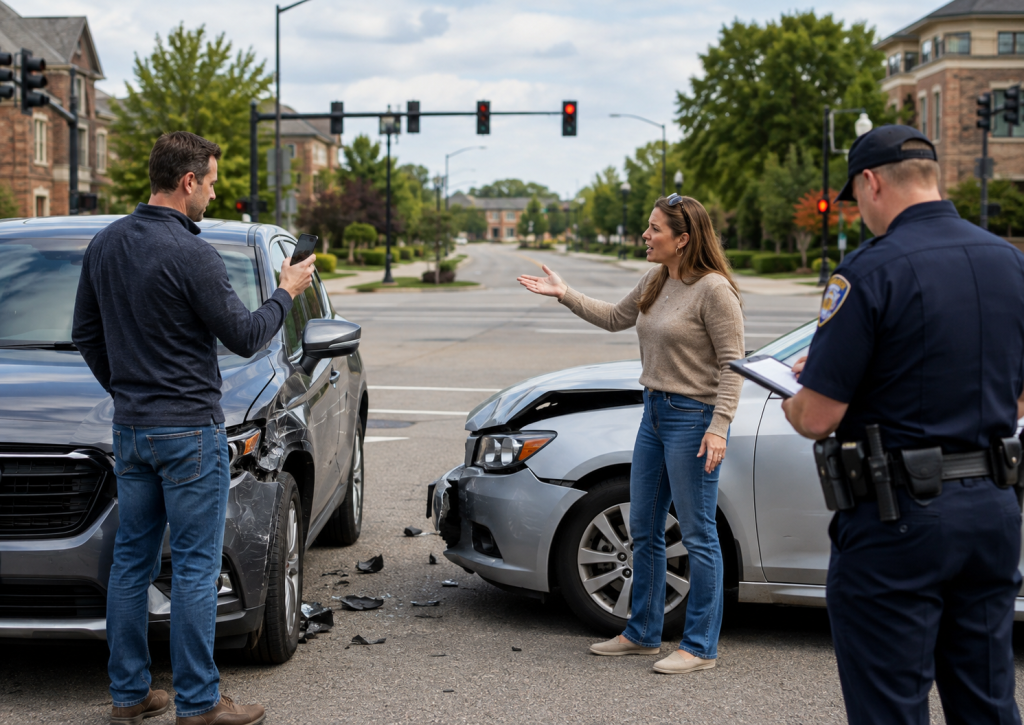
Quick Answer: If the other driver blames you after a Carmel car accident, that does not automatically make you responsible. Avoid admitting fault or guessing about what happened, preserve the available evidence, and document what you remember while the details are fresh. Indiana comparative-fault rules allow responsibility to be divided when more than one person contributed to a crash.
How Is Fault Determined After a Carmel Car Accident?
The drivers do not decide fault simply by accusing each other. Insurance companies may make their own liability determinations while handling a claim, and if the dispute becomes a lawsuit, a judge or jury may ultimately determine fault based on the evidence and Indiana law.
Indiana uses a modified comparative-fault system. When an injured person shares responsibility for a crash, compensation can generally be reduced by that person’s percentage of fault. A claimant found to be more than 50% at fault generally cannot recover from the other responsible party.
That means a crash does not always have to be entirely one driver’s fault. One driver might make an unsafe lane change while another is speeding or fails to react reasonably. When the drivers give different accounts, the issue is usually resolved by looking at the evidence rather than accepting whichever person assigns blame first.
A police report can be important, but it does not automatically determine legal fault in an insurance claim or lawsuit. The report may document driver statements, witnesses, vehicle positions, roadway conditions, citations, and other observations, while later-obtained evidence may add information that was not available at the scene.
What Evidence Can Help Show Who Caused the Crash?
When the drivers disagree, physical and electronic evidence can become especially important. If you can safely do so, photograph the vehicles from several angles, points of impact, debris, skid or tire marks, lane markings, traffic controls, roadway conditions, and the wider crash scene.
Independent witnesses may have seen a light change, turning movement, lane change, speeding vehicle, or another detail that one of the drivers missed. Dashcam footage, surveillance video from nearby businesses or homes, and recordings from other vehicles may also help establish vehicle position and the sequence of events before impact.
Vehicle damage can provide additional context about the location and angle of the collision. Indiana crash-investigation training recognizes roadway evidence, vehicle evidence, scene photography, measurements, and driver and witness interviews as important parts of determining how a collision occurred.
Preserve evidence as early as reasonably possible. Video can be overwritten, vehicles may be repaired, and witnesses can become harder to locate as time passes.
What Should You Do If the Other Driver or Insurance Company Blames You?
Stay calm and focus on safety, medical needs, and accurate documentation. When speaking with police or an insurance adjuster, tell the truth but do not estimate speed, distance, timing, or other details if you are unsure. If the other driver immediately says the crash was your fault, you do not need to agree simply to end the conversation.
If an insurer later says you were partly or entirely responsible, ask how that conclusion was reached and what evidence supports it. Keep copies of claim documents, emails, photographs, repair records, medical records, and notes from conversations with the insurer.
Be cautious about broad recorded statements, medical authorizations, releases, or settlement documents while fault is still being disputed. A settlement generally requires a release that can end the claim, so understand how fault, injuries, insurance coverage, and documented losses are being evaluated before resolving it.
Anthony “Tony” Oliveira of Dennis, Wenger & Abrell, P.C. handles personal injury matters involving motor vehicle accidents in Indiana.
Frequently Asked Questions About Fault After an Indiana Car Accident
No. Another driver’s accusation does not automatically determine fault. Responsibility depends on the available evidence, traffic rules, and circumstances of the collision.
Possibly. Indiana comparative-fault rules may reduce compensation when an injured claimant shares responsibility for the crash. The effect depends on the percentage of fault assigned.
Review the report carefully and preserve any evidence that supports your account. A police report can be important, but it is not the only evidence that may be considered when fault is disputed.
Be courteous and focus on checking for injuries and exchanging necessary information. Avoid making broad statements about responsibility when you may not yet know all of the facts.
Useful evidence can include crash-scene photographs, vehicle damage, independent witnesses, dashcam or surveillance footage, roadway evidence, and police documentation. The most useful evidence will depend on how the crash occurred and what facts are disputed.
Contact Dennis, Wenger & Abrell, P.C.
If fault is being disputed after a Carmel car accident, avoid accepting blame or resolving the claim before you understand the evidence and how Indiana comparative fault may apply. Contact Dennis, Wenger & Abrell, P.C. to discuss the accident, available insurance, and the circumstances surrounding the fault dispute.
Legal Disclaimer
This article is for general informational purposes only and is not legal advice. Reading it does not create an attorney-client relationship with Dennis, Wenger & Abrell, P.C. Fault and insurance issues depend on the specific facts, available evidence, policy language, and applicable law. Speak with a qualified Indiana attorney about your situation.