
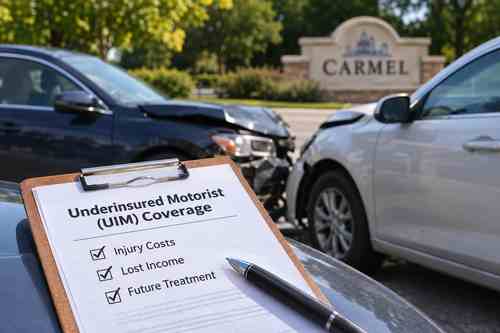
Quick Answer: If the driver who caused your Carmel crash does not have enough insurance to cover your injuries and losses, underinsured motorist coverage may help. Whether it applies depends on the insurance limits available, your own policy, the value of your claim, and the facts of the crash.
What Is Underinsured Motorist Coverage?
Underinsured motorist coverage, often called UIM coverage, may apply when the at-fault driver has insurance but does not have enough coverage for a serious injury claim.
In Indiana, newly written auto liability policies generally include uninsured and underinsured motorist coverage unless it is rejected in writing. Indiana also requires insurers to make underinsured motorist bodily injury coverage available in limits of at least $50,000.
What Is the Difference Between Uninsured and Underinsured Coverage?
Uninsured motorist coverage may apply when the responsible driver has no insurance. Underinsured motorist coverage deals with situations where the responsible driver has insurance, but the available coverage may be too limited compared with the UIM coverage available to the injured person and the value of the claim.
In practical terms, UIM coverage can become important when the at-fault driver’s insurance is not enough to address a serious injury claim. Indiana courts have described UIM coverage as protection for people injured by drivers who are not adequately insured.
How Does an Underinsured Motorist Claim Work?
The claim usually starts with the insurance available from the driver who caused the crash. If that coverage is not enough, UIM coverage under another applicable policy may need to be reviewed.
The insurer may look at who caused the crash, the injuries, medical treatment, available insurance, policy limits, and the terms of the policy. A UIM claim is not paid automatically just because the other driver has lower limits.
What Losses May Matter in a UIM Claim?
A serious injury claim may involve medical bills, lost income, future treatment, and other losses caused by the crash. The value of the claim depends on the injuries, supporting records, available insurance, and policy terms.
If your medical bills are already close to or higher than the other driver’s available insurance, that may be a reason to review additional coverage. But medical bills alone do not determine the value of the claim. Future care, time away from work, and long-term limitations may also matter.
Should You Accept the Other Driver’s Policy Limits Right Away?
Not always. Before accepting a policy-limits offer or signing a release, it is important to review whether UIM coverage may apply.
Indiana law includes procedures that can affect an insurer’s rights when a settlement with the at-fault driver is being considered. Your policy may also contain notice, consent, or cooperation requirements. Because of that, settling the first claim too quickly can create problems with a later UIM claim.
Is a UIM Claim Made Through Your Own Insurance Company?
Often, yes. That can feel confusing because another driver caused the crash, but UIM coverage comes from a policy that may protect you when the at-fault driver does not have enough insurance.
Your insurer can still investigate the claim and may ask for accident details, medical records, proof of losses, and other information before deciding whether coverage applies.
What Insurance Policies Should Be Reviewed?
The at-fault driver’s policy may not be the only coverage that matters. Depending on the facts, coverage may come from your own auto policy, the policy covering the vehicle you were riding in, or another policy under which you qualify as an insured person.
Reviewing the actual policy language is important because coverage can vary from one situation to another.
What Records Should You Keep?
Keep copies of your insurance policy, declarations page, claim numbers, settlement offers, and insurance correspondence. You should also keep medical bills, treatment records, the crash report, photos, proof of missed work, and other records showing how the crash affected you.
These records can help explain both the value of the injury claim and why the available liability insurance may not be enough.
When Should You Talk to a Carmel Car Accident Attorney?
It may help to speak with an attorney if your injuries are serious, the other driver has low insurance limits, your insurer is asking for detailed information, or you are being asked to sign a release.
An attorney can review the available policies, explain which coverage may apply, and help protect the claim before a final settlement is accepted. Dennis, Wenger & Abrell, P.C. handles personal injury matters involving car crashes through its Carmel office.
Frequently Asked Questions
If the available liability coverage is not enough to address your losses, UIM coverage or another applicable policy may need to be reviewed.
Indiana generally requires newly written auto liability policies to include uninsured and underinsured motorist coverage unless the insured rejects the coverage in writing.
No. The insurer may review fault, injuries, damages, other available insurance, and the policy terms before deciding whether coverage applies.
Possibly. UIM coverage may become relevant when the insurance available from the at-fault driver is not enough and the requirements of the applicable policy and Indiana law are met.
Be careful. Review possible UIM coverage and any notice or consent requirements before signing a final release or accepting a policy-limits settlement.
Review Your Coverage and Injury Claim With a Carmel Attorney
If the driver who caused your Carmel crash does not have enough insurance, it is important to review all available coverage before accepting a final settlement.
Dennis, Wenger & Abrell, P.C. can help determine what insurance coverage may apply and explain the next steps. Learn more about DW&A’s Personal Injury and Wrongful Death services, visit the firm’s Carmel office page, or contact Dennis, Wenger & Abrell, P.C. to discuss your situation.
This article is for general information only and is not legal advice. Insurance coverage and legal rights depend on the facts of the crash, Indiana law, and the terms of the insurance policies involved.